
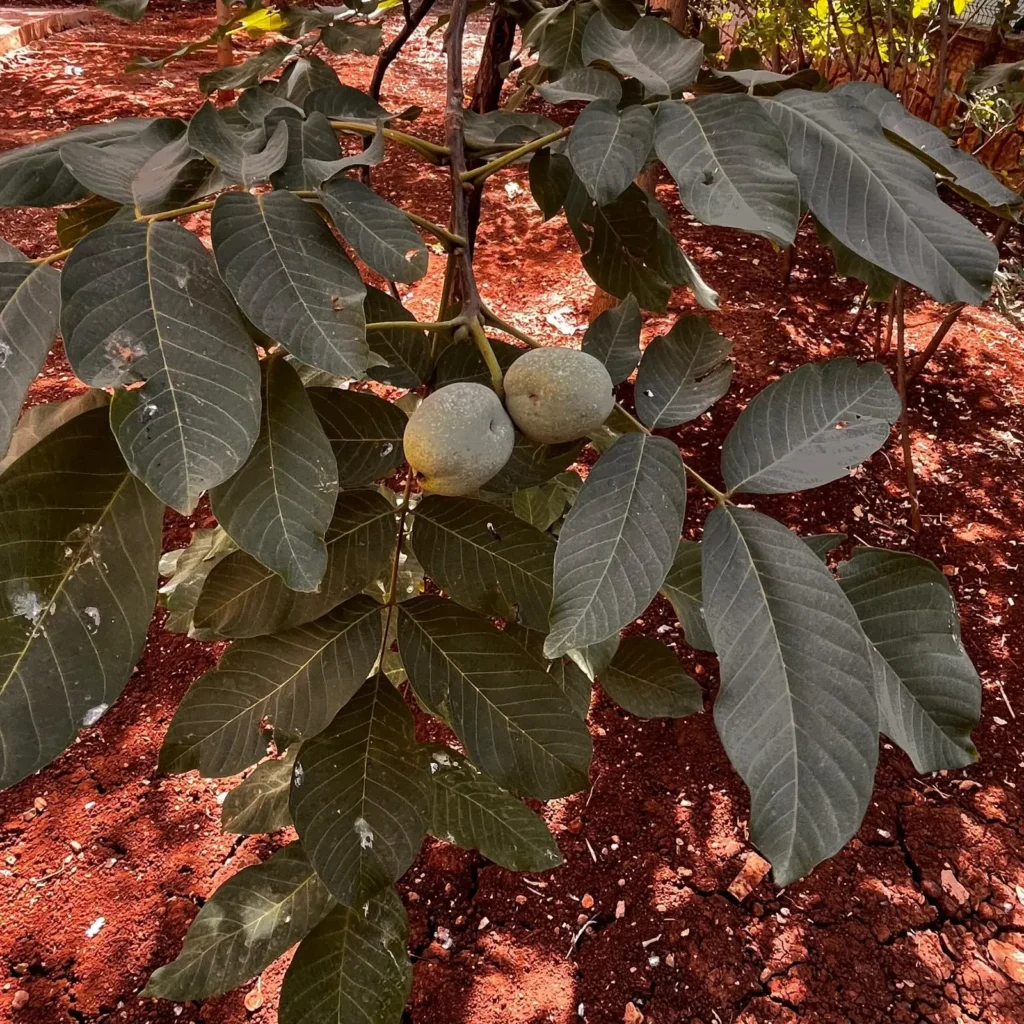
English Walnut
Juglans regia
Updated Sep 6, 2026
English Walnut (Juglans regia), also known as Persian Walnut, is a large deciduous shade tree valued for its mild, thin-shelled nuts. It grows best in a spacious, sunny site with deep soil, reliable drainage, and room for a broad crown.
About English Walnut
English Walnut develops into a broad, long-lived deciduous tree that provides edible nuts and generous summer shade. A mature specimen commonly reaches about 40–60 feet (12–18 m) in height and spread, so it belongs in a large yard rather than a narrow border or a position close to a building.
Its rounded crown carries compound leaves made up of several smooth-edged leaflets. Male flowers hang in catkins, while much smaller female flowers form near new shoots. After pollination, each nut develops inside a smooth green hull that changes color and splits as the nut ripens in fall.
This tree needs patience and a permanent location. Its strong taproot makes established specimens difficult to move. A grafted cultivar is generally more predictable for nut quality, ripening time, and mature size than a tree raised from an unknown seed.
How to Care for English Walnut
Watering
English Walnut needs moderate but dependable moisture. A newly planted tree has a limited root system and should be watered deeply whenever the surrounding soil begins to dry. Apply water across the root area rather than pouring a small amount directly against the trunk.
As the roots spread, watering can become less frequent. Extra moisture is still important during long dry periods, particularly while the nuts are developing. Dry soil may show as drooping foliage, scorched leaf margins, weak shoot growth, or nuts that fail to fill properly.
Constantly saturated ground is equally damaging. Water that remains around the roots can lead to poor growth and root or crown decline. A 2–3-inch (5–7 cm) layer of organic mulch limits moisture loss, but leave a clear space around the trunk so the bark stays dry and visible.
Sunlight
Place English Walnut in full sun, with open exposure for most of the day. Strong light supports sturdy branching, healthy foliage, and reliable nut development. A young tree may survive light shade, but a permanently shaded position can produce an uneven crown and disappointing crops.
Consider how nearby trees and buildings will change the light as the landscape matures. Some protection from severe wind is helpful, but the site should not be enclosed. Avoid low ground where cold air settles around spring flowers.
Temperature
English Walnut grows best when temperatures remain around 59–86°F (15–30°C) during the active growing season. Mild spring weather supports budbreak, flowering, and new shoot development, while warmer summer conditions within this range promote leaf growth, nut filling, and ripening.
The tree requires a period of winter chilling before growth resumes in spring. Once buds open, frost can damage flowers and tender shoots, while prolonged heat above the ideal range may interfere with growth and fruit development, particularly when the soil is dry.
Humidity
English Walnut is best suited to moderate humidity with good airflow. Its canopy needs enough surrounding space for leaves to dry after rain. Persistently humid conditions combined with crowded branches can favor leaf spots, blight, and shoot damage.
No special humidity treatment is needed outdoors. Direct irrigation toward the soil and avoid repeatedly wetting the canopy late in the day. Selective removal of crowded or damaged branches can improve air movement without creating large wounds throughout the tree.
Soil
A deep, well-draining loam gives English Walnut a suitable balance of moisture, nutrients, and root aeration. The ground may contain organic matter and remain slightly moist after watering, but excess water should move away instead of collecting around the root crown.
Shallow, compacted, or persistently wet soil restricts the tree’s deep root system. Observe the location after heavy rain before planting. Standing water or ground that stays sticky and saturated for a long period indicates that another site or a broad raised planting area may be necessary.
Avoid making a small pocket of heavily amended soil inside dense clay. This can trap water around the roots and discourage them from extending into the surrounding ground. Gradual improvement across a wide area creates a more stable root environment.
Planting & Root Space
Choose a young tree with an undamaged trunk and roots that are not tightly circling the container. Dig a hole wider than the root system but no deeper than needed to keep the root flare at ground level. Spread the roots carefully, backfill around them, and water thoroughly to settle the soil.
Keep the tree well away from foundations, drains, pavement, overhead wires, and areas where falling nuts would be inconvenient. English Walnut also releases juglone, a natural compound that can affect certain sensitive plants, although the effect is usually less pronounced than it is beneath Black Walnut. Shade and root competition can add to the difficulty of gardening under the mature crown.
Pollination & Nut Production
Male and female flowers grow separately on the same tree, and wind carries pollen between them. Some cultivars can produce nuts alone, but both flower types may not be ready at the same time. A second compatible cultivar with overlapping bloom can improve nut set and make production more dependable.
Poor nut set on a healthy tree may result from spring frost, weak pollination, insufficient sunlight, or dry soil while the crop is developing. Grafted trees may begin bearing while relatively young, but substantial harvests require time, and a heavy crop may be followed by a lighter year.
Feeding
A healthy English Walnut in fertile soil may need little additional fertilizer. Normal shoot growth, full-sized green leaves, and regular nut development usually indicate adequate nutrition. If growth remains weak despite suitable water and light, a soil test can identify a deficiency before fertilizer is added. Apply any needed product in spring and keep it away from the trunk.
Pruning & Training
Train a young English Walnut around one strong central leader with well-spaced side branches. Remove competing leaders and branches with weak attachments before they become large. Early structural training reduces the need for major cuts later.
Established trees require only limited pruning to remove dead, damaged, rubbing, or badly positioned wood. Late summer through early fall is a suitable period for necessary work because walnuts can release considerable sap when cut near the start of spring growth. Avoid hard pruning or removing a large portion of the canopy in one season.
Harvesting
Walnuts are ready when the outer green hulls begin to split and mature nuts loosen or fall naturally. Collect them promptly so they do not remain in wet grass or become damaged by wildlife. Wear gloves while removing the hulls because their dark juice can stain skin, clothing, and nearby surfaces.
Discard nuts with visible mold, cracks, or poorly developed kernels. Spread the sound nuts in a single layer in a dry place with moving air. Once they are fully dried, store them in a cool, dry container to preserve their flavor.